
Outcome
Earlier
insight, in simulation
Without modelswaits for hardware
With modelsfirst insight
concepthardware readyrelease
Earlier insight
Control behaviour is explored in simulation long before hardware is available.
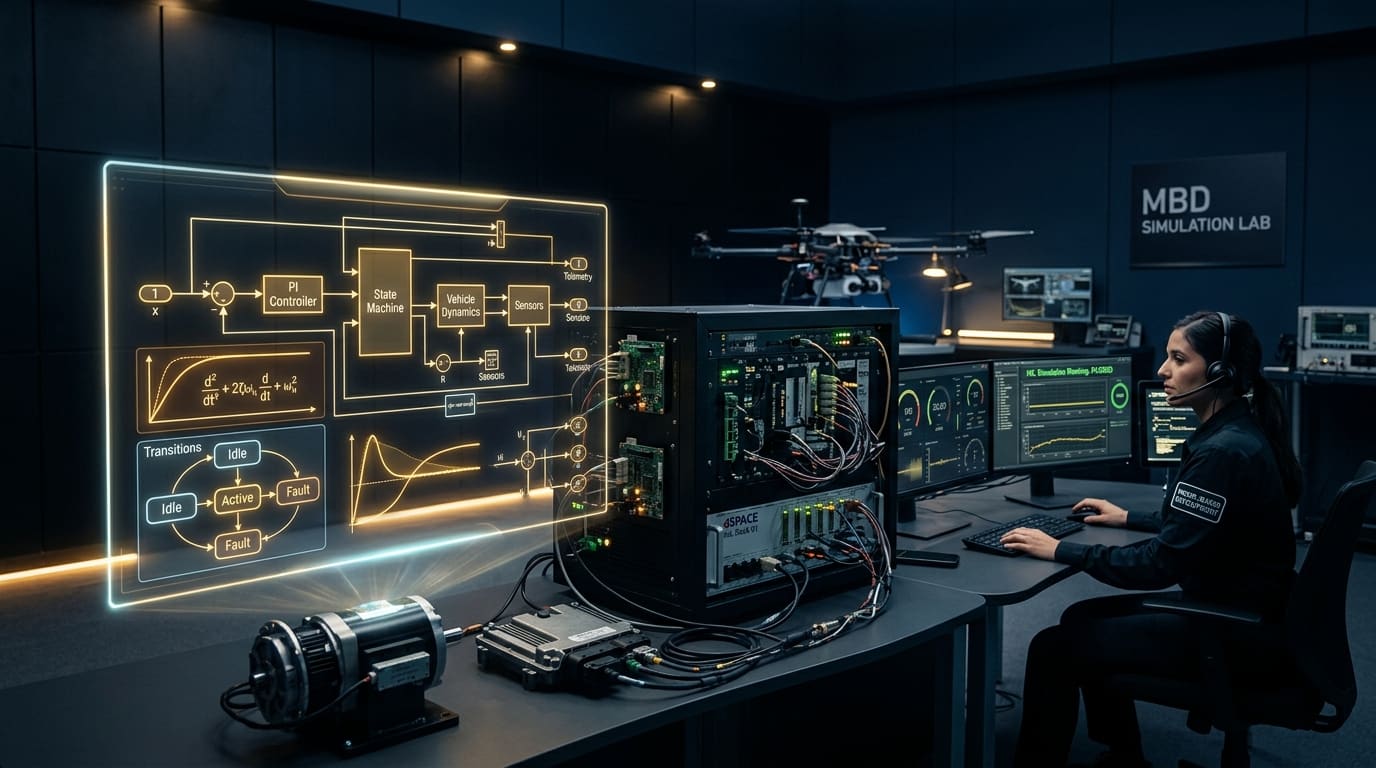
We help engineering teams use model-based development to improve control-system design, simulation, testing and software implementation.
Closed-loop model · simulation
Practice overview
Model-based development shortens the loop between an idea and verified embedded software. We build and validate control algorithms in simulation, generate production code from the models, and integrate it cleanly into the wider software stack.
Signal
Powertrain & e-mobility
Signal
Industrial control
Signal
Motor & power electronics
Signal
Mechatronic systems
A live model canvas pick a stage and follow the signal from the first block to the last back-to-back check.
Stage · Algorithm modelling
Control logic captured as executable, reviewable models.
Scope · illustrative
The same scenario runs in the model, on the host and on the target. Move the tolerance and see which loop still agrees.
Same scenario · three runs
Model-in-the-loop
The algorithm is exercised in simulation, with the model as the reference.
Software-in-the-loop
Generated code is compiled and run on a host machine against the same scenarios.
max |Δ| = 0.0036
Processor-in-the-loop
The code runs on the target processor, confirming real-world numerical behaviour.
max |Δ| = 0.0120
Scroll through the four phases and watch the same control loop get tuned less overshoot, a faster settle, a signal you can trust.
Overshoot
73%
Settling
4.00 s
Damping ζ
0.10
Control requirements are turned into an executable model structure with clear interfaces and signal definitions.
ζ 0.10Algorithms are tuned against plant models and scenarios, so behaviour is understood before it reaches hardware.
ζ 0.28Production code is generated from the model and integrated with drivers, scheduling and the surrounding stack.
ζ 0.55Generated code is verified against the model through MIL, SIL and PIL runs, keeping simulation and target in agreement.
ζ 0.85Drag your eye across the canvas: each deliverable is a block, each handover a wire and the tooling it is built with sits in the library.
Library browser
Structured, documented models and interface definitions
Simulation scenarios and result reports
Generated production code, integrated into your stack
Back-to-back test evidence
Modelling guidelines for your team
Each outcome, shown the way an engineer would measure it.
Outcome
Earlier
insight, in simulation
Without modelswaits for hardware
With modelsfirst insight
Control behaviour is explored in simulation long before hardware is available.
Outcome
Zero
translation slips
Hand-translated
err = sp - fb;
i += Ki*err*T;
out = Kp*err+i;
cmd = out;
Write(cmd);
Generated
err = sp - fb;
i += Ki*err*Ts;
out = Kp*err+i;
cmd = sat(out);
Write(cmd);
Generated code removes a class of manual translation errors.
Outcome
Many
products, one model
Well-structured models carry over across products and variants.
Model-based work does not sit beside your lifecycle it runs straight through it. Watch the signal travel from the first requirement to the release evidence.
Five ways to engage on model-based development pick the one that fits your roadmap.
Best for
Defined scope and delivery timeline
Pick a query on the left the response appears in the inspector.
Something specific to your model or toolchain?
Ask our engineers
Whether it is embedded software, AUTOSAR, ECU engineering or a full device-to-cloud product our teams will help you identify the right solution path.
I'm building…
Requirements & architecture
Systems Engineering
Firmware, drivers & middleware
Embedded Software
Diagnostics & communication stacks
Automotive Software
ECU testing & validation
V&V and Test Automation
Suggested engagement
Project-based delivery